

To clone the demo application, run the following commands:
1
Clone the application
2
Install the dependencies:
3
Run the application:
Setting up Hanko Passkey Authentication:
1
Setup your Hanko Webapp
Visit the Hanko webapp, create a new organization (Or use your existing one), and give it the name you want.
2
Create a new project
In the main dashboard, create a new project - assign http://localhost:3000 as
the App URL.
3
Copy API URL
From the Settings > General section of the project, copy the API URL.
4
Paste API URL
Paste the API URL to a new file called
.env.local, in the root directory of
the application. When we run the application again, we can see that the error
is gone, and we can see the login page.Now, when we run the application again,
we can see that the error is gone, and we can see the login page.5
Add the authentication window
To add this authentication window, use the Hanko SDK for JavaScript. You can see the element that implemented the login flow in the
app/auth/login/page.tsx file.6
Redirection Logic
We added the following middleware logic to the With the authentication configuration and flow configured, we are ready to continue with the implementation of Permit.io for authorization in our application.
middleware.ts file that redirects the user to the login page if they are not authenticated:Setup Basic Role Based Authorization
With authentication done, it is time to set up our authorization layer. We’ll start with setting up basic role-based access control (RBAC) to determine the actions our users can perform. In the/app/api/notes/route.ts,
you’ll find four functions, GET, POST, PUT, and DELETE - responsible for the logic of getting, creating, updating, and deleting notes,
respectively.
If you look at the route.ts file, you will see that we are going to use a generic
permit.check middleware.ts
file.
permit.check function that checks the permissions configured for the application using three factors:
User - the entity that attempts to perform the operation (in our case, a user authenticated with Hanko).
Action - the operation that the user will attempt to perform (in our case, GET).
Resource - the entity that the user will attempt to perform the operation on (in our case, the note).
At this point, we haven’t configured the Permit SDK key in the app, so any
user can perform any operation. Setting up a Permit.io account will fix this.
1
Create a Permit.io account
Go to app.permit.io, Create an account, set up a new
organization, and give it whichever name you want.
2
Create Roles
In the left sidebar, click on Policy, then go to the Roles tab, and create
the following roles: Admin and User.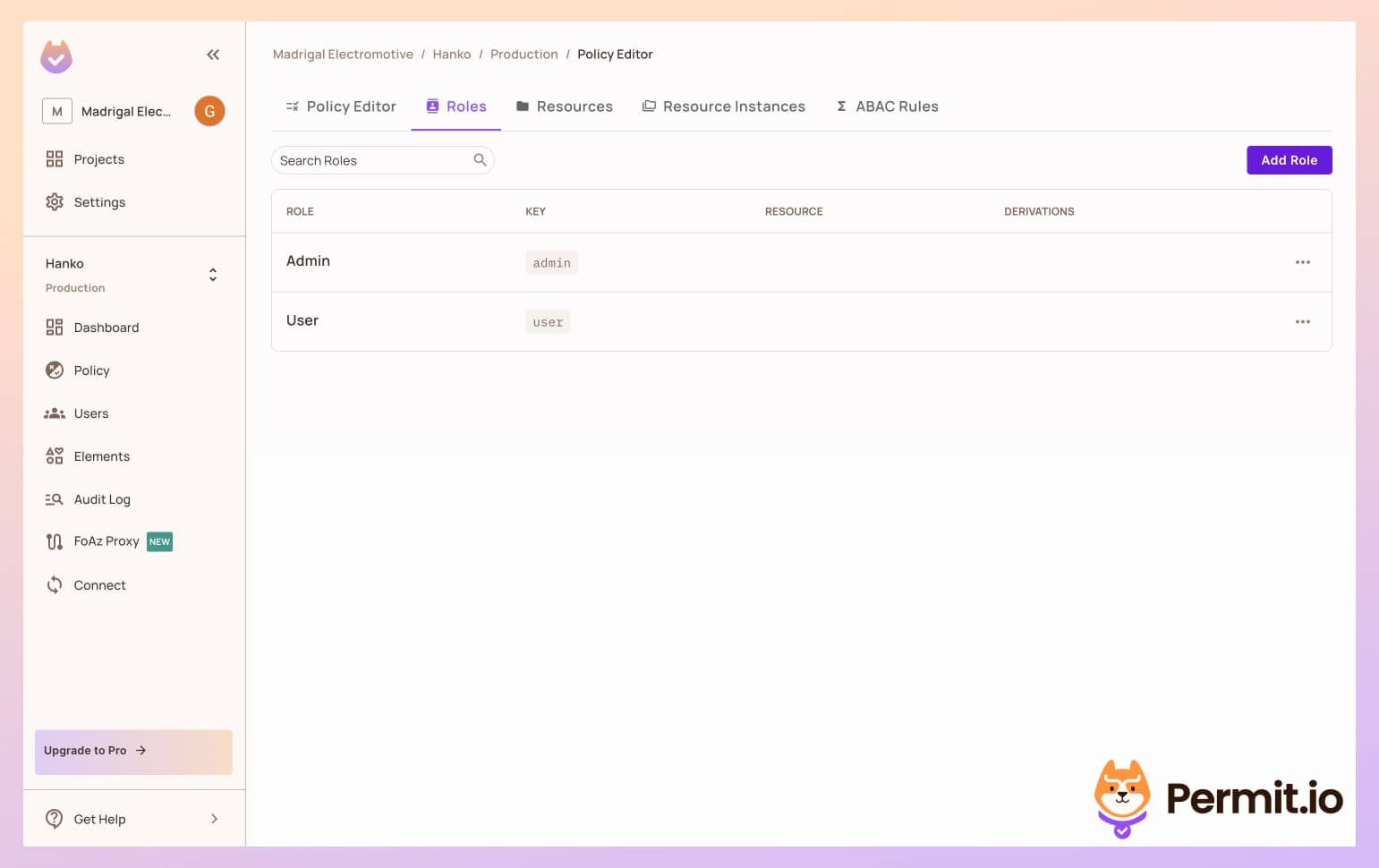
3
Create Resources and Actions
In the Resources tab, create a new resource called notes, with the following four actions and an owner attribute: 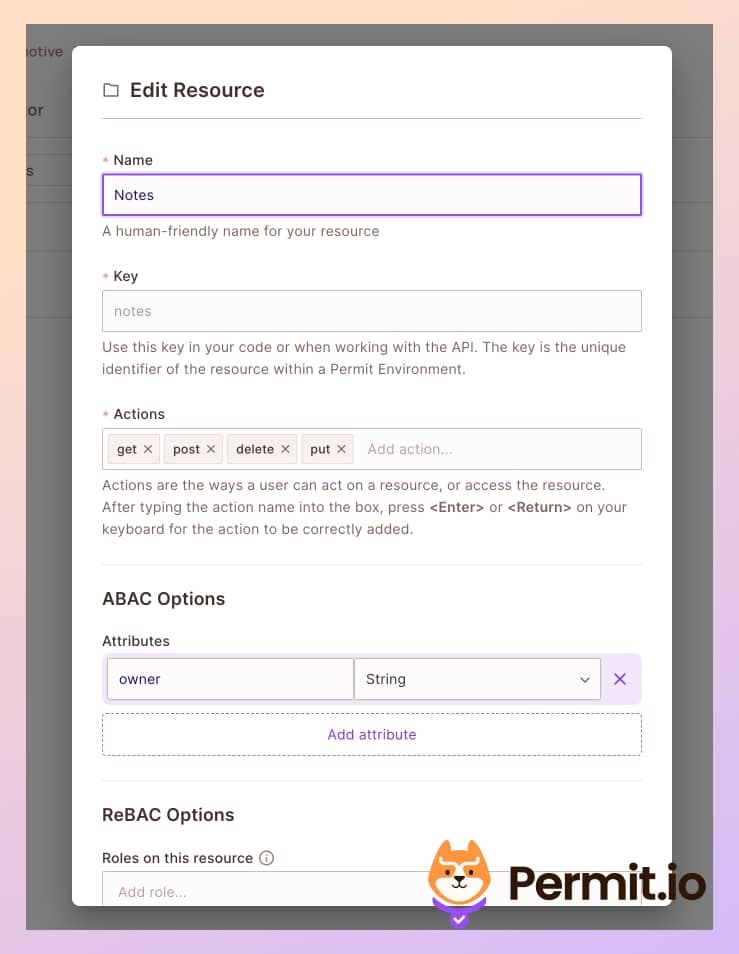
get, post, delete, and put.4
Setup Permissions
Back in the Policy tab, let’s allow all users to get and 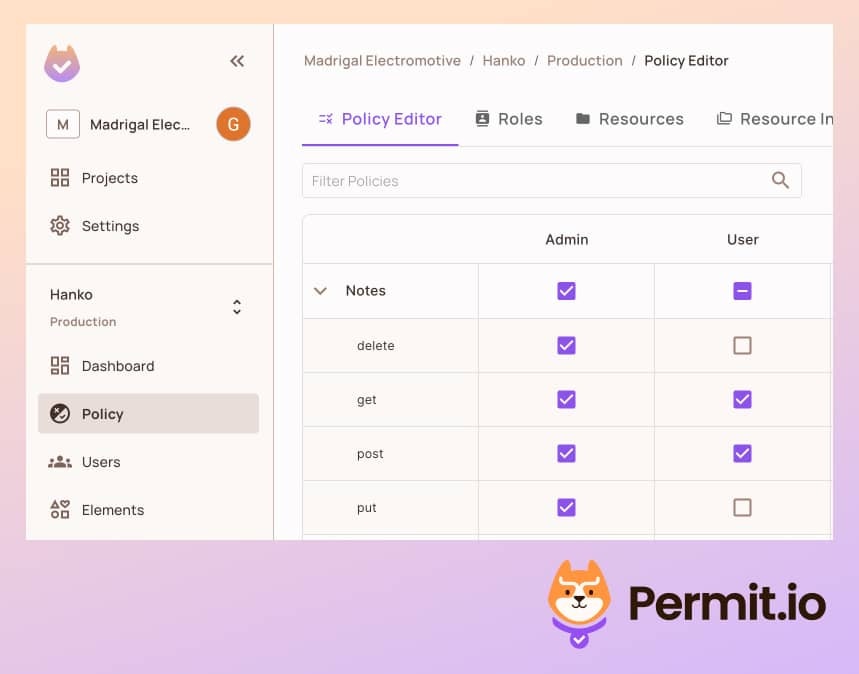
post notes, and only admins to put, and delete notes.5
Setup API Credentials
To copy your API key, click your user profile in the top right of the screen, and click
Copy SDK API Key.
Add the key in your in the env.local file:6
Configure the API endpoint
We will also need to configure the Permit.io API endpoint to check the permissions. For this purpose, we will use the Permit cloud service.
Sync Hanko Users to Permit.io
To check the permissions we configured, we need to sync the users from Hanko to Permit.io, so our users will be known to the Permit policy engine. We will want to automatically assign a user role to every new user, so they will also be part of our newly configured policy. This role helps us to keep the principle of least privilege and give new users only very basic permissions in the application. In the demo application, you can find the following code in thesrc/app/api/permit/route.ts file:
Check the Permissions
1
Login with a user
In the
localhost:3000 page, log in with a user of your choice, and make
sure you have the right passkey configured.2
Create a new note
Create a new note on the first screen of the application. It should appear
on the list.
3
Check the Audit Logs
In the Permit.io Dashboard, go to the Audit Log tab in the left sidebar. You
should see that the 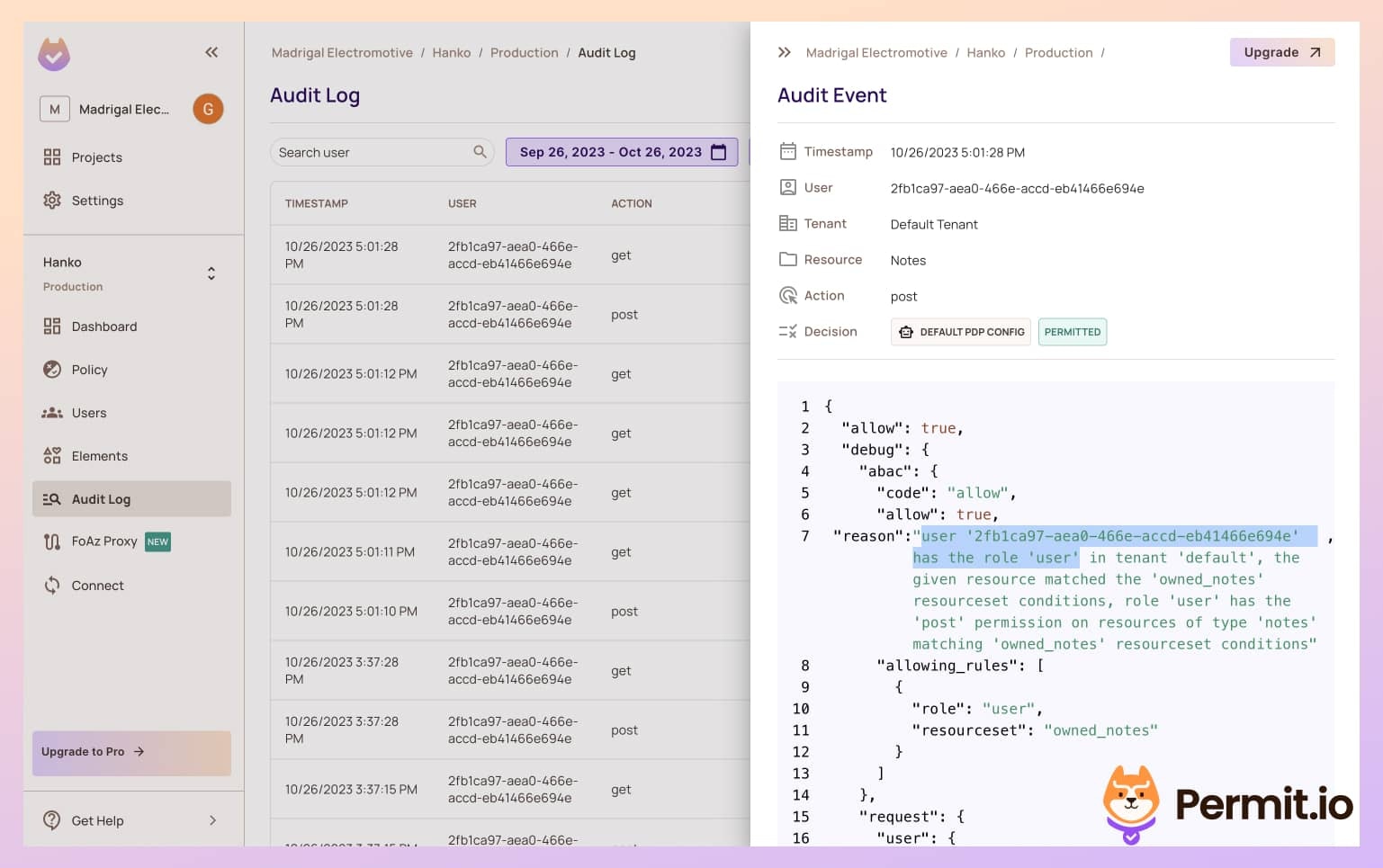
post action was logged. Clicking the log will allow
you to see detailed information about the authorization decision that
allowed for this action to be performed. Allow will equal true as this
user has the User role.4
See the permissions in action!
If we try to delete the note, we will get an error message saying we are not
allowed to access this resource. If we grant an Admin role to this user via
Permit.io’s UI, the error will be resolved and we will be able to delete the
note.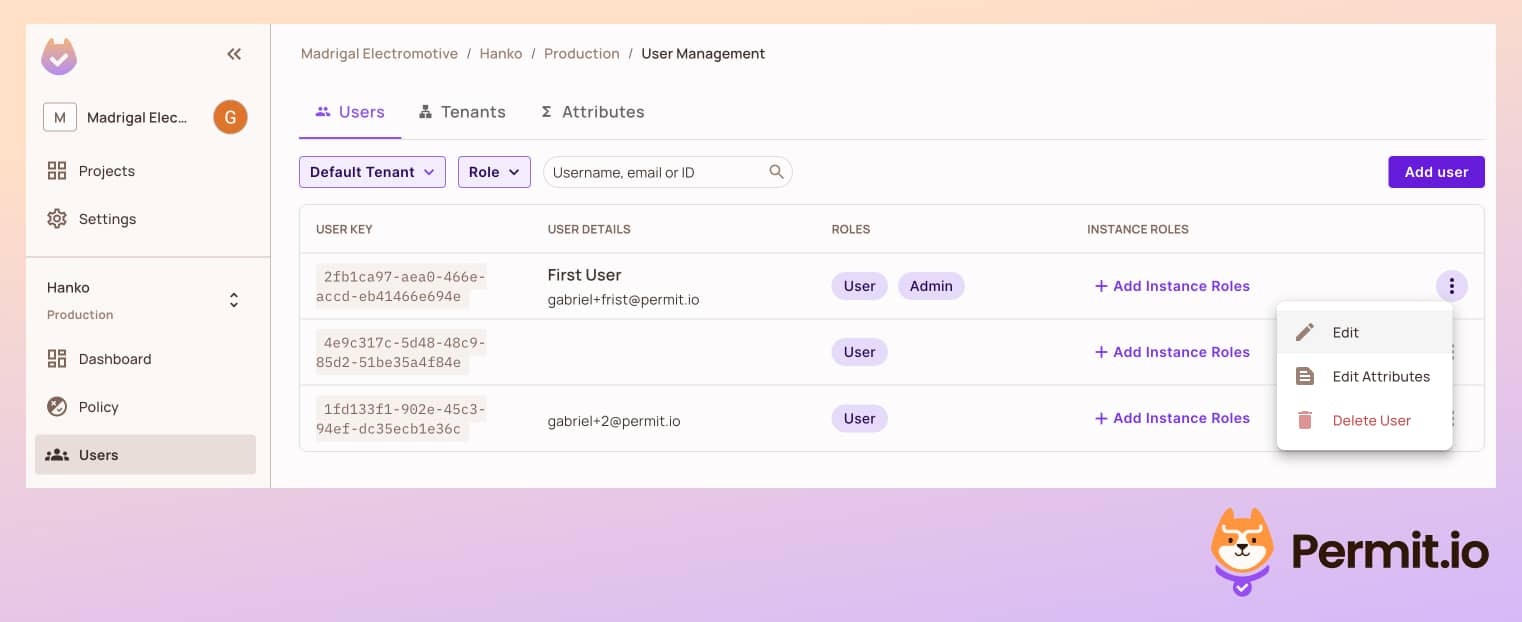
Add Fine-Grained Attribute-Based Authorization
For this section to run properly, you need to run the Permit.io PDP as a
sidecar. You can read how to do that
here.
1
Enable ABAC in Permit Dashboard
Navigate to the Policy page, select ABAC Rules, and activate the ABAC
option.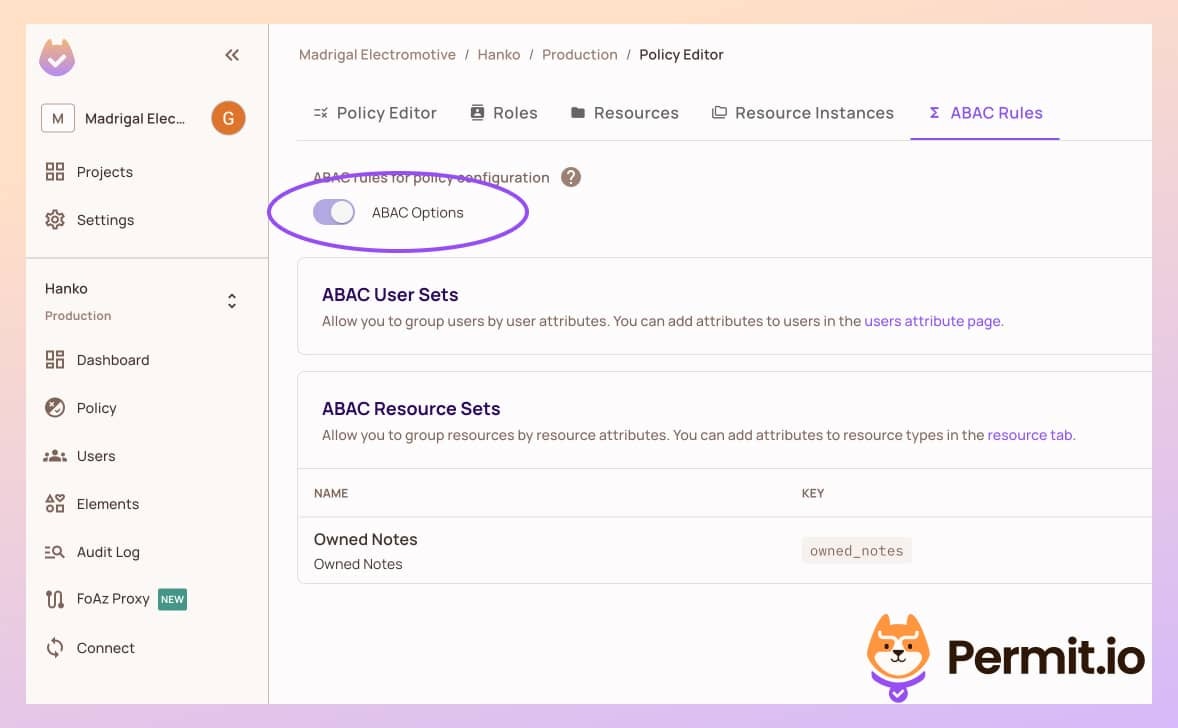
2
Define Resource Set Rule
Go to the Resources tab and create a new Resource Set rule. This rule should
validate if the user is the note’s owner.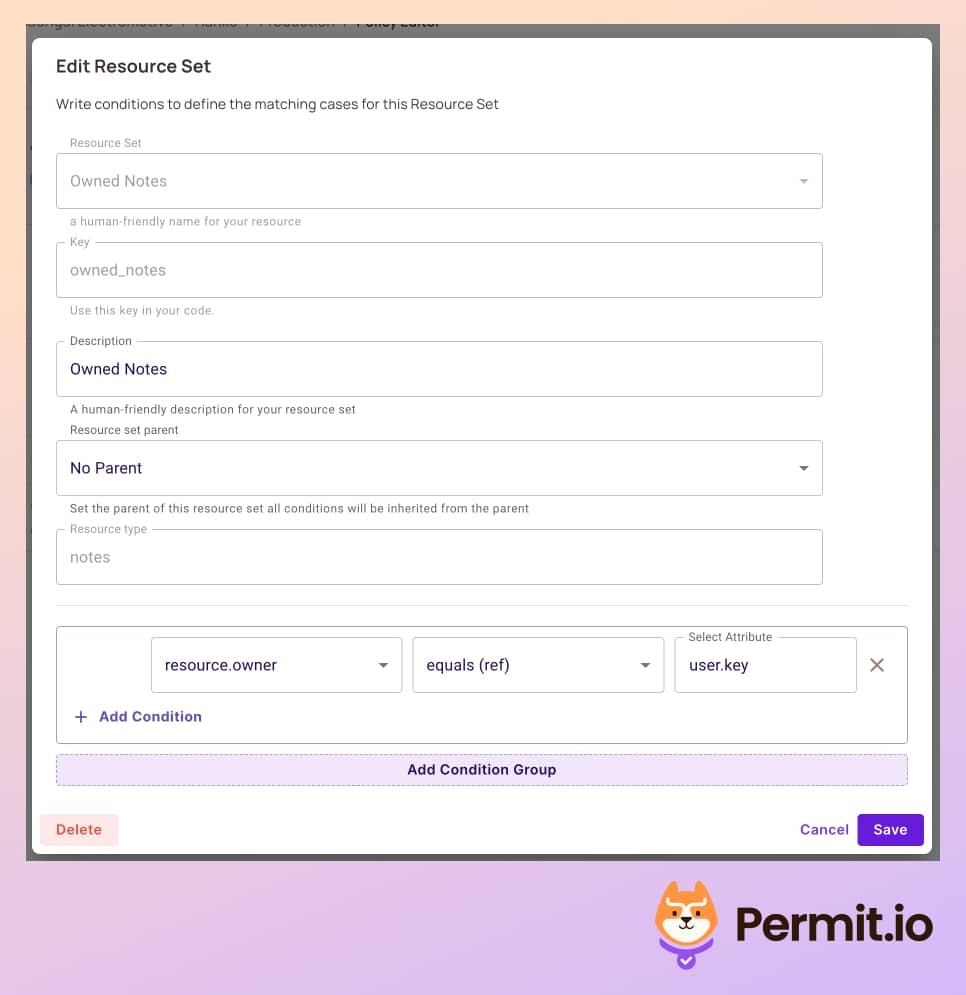
3
Create a New Policy
Return to the Policy tab and establish a policy allowing 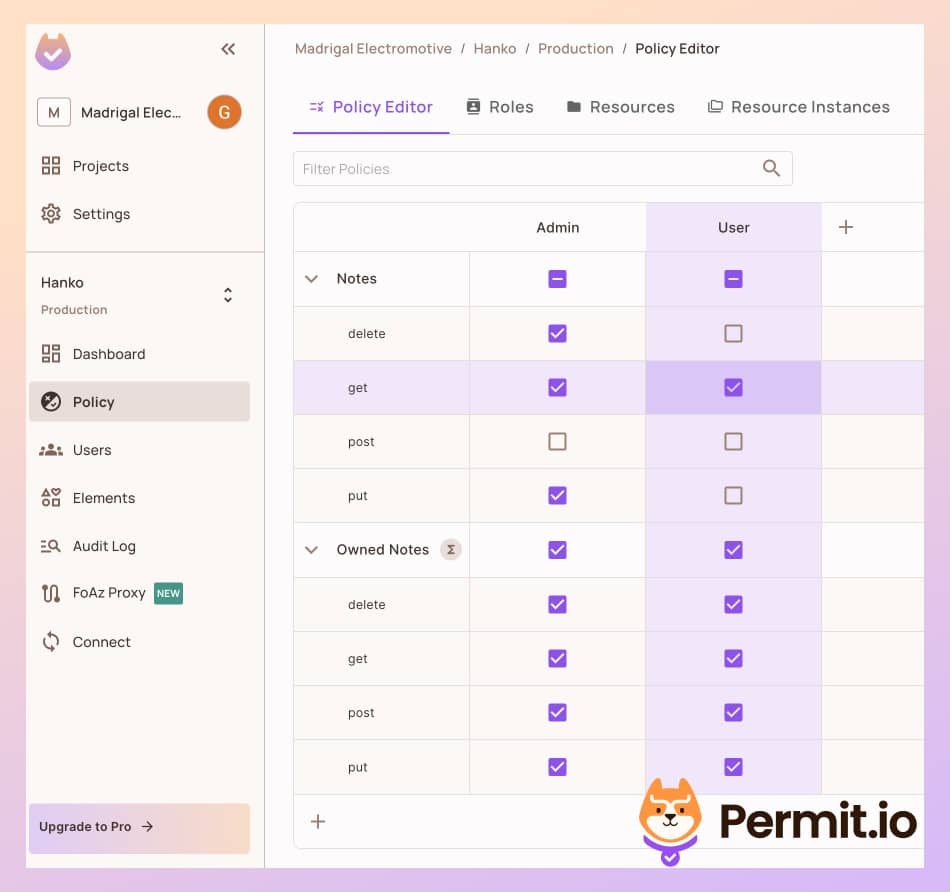
put and
delete actions exclusively for the note’s owner. Ensure the admin role
retains all-action privileges.4
Test with a New User
Log out from the current user, register a new user, and verify that this new
user cannot delete tasks.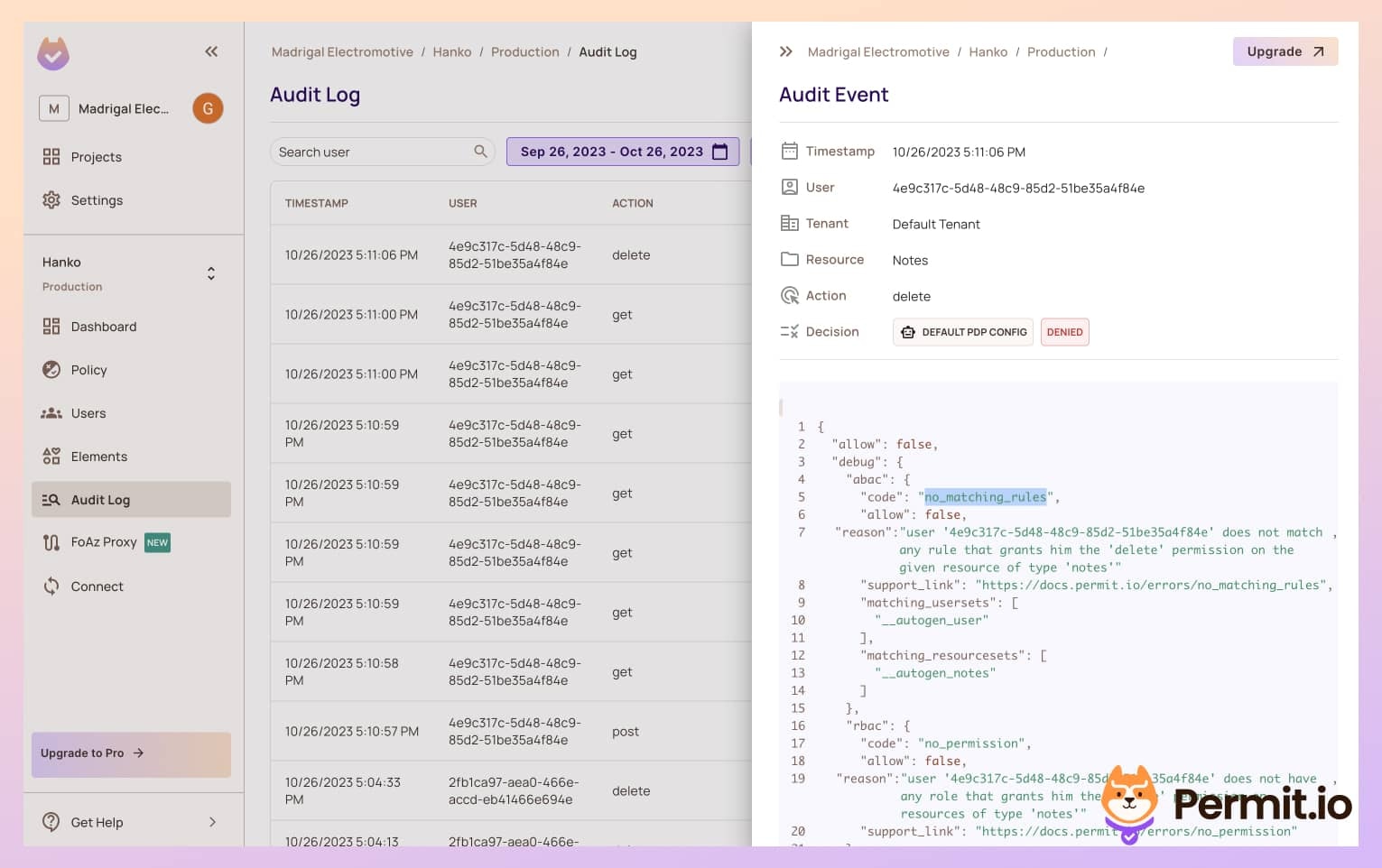
5
Create and Delete a Note
As the new user, create a note and confirm the ability to delete the newly
created note.
6
Cross-User Deletion Test
Log in with a different user after creating the note and attempt to delete it. This should fail, as the logged-in user is not the creator.
Enforce Permissions Everywhere
Sometimes, you will encounter a situation where you need to check permissions in the middle of the application logic. For example, you could want to restrict a particular operation to premium users only. Using Permit, the policy configuration always remains the same, and you’ll only have to use thepermit.check function in every place within the code to determine allowed/not allowed permissions.
permit.check function also lets you make decisions based on data that might not exist in the scope of the request in the middleware, so you get more granular decisions with no code changes.
Add Fine-Grained Relationship Based Authorization
Another approach for fine-grained authorization that we can use is Relationship-Based Access Control (ReBAC). Assuming a note app, we might want to create workspaces, organizations, and folders for our notes. In this case, we might do not have a dedicated owner field in the note entity, but we have a relationship between the note and the workspace. Permit also supports the configuration of ReBAC policies, we can easily implement it in our application without changing thepermit.check or any enforcement code in the app. Read more about modeling ReBAC here.